History of Ibiza
A Rich Cultural and Historical Heritage

Ibiza is a place with a rich cultural and historical heritage. The island has seen many civilizations rise and fall. It is hard to believe, but Ibiza has been settled by advanced civilizations for roughly 2,700 years. Even more stunning, there are monuments that can be seen today which date back to these periods.
The Punic People on Ibiza
Around 700 BC, Carthage was one of the most important cities in the world. It was located in North Africa. Its inhabitants were called the Punic people, or less specifically, Phoenicians. They were seafarers and busy traders with people living along the shores of the Mediterranean Sea. To support these activities, it was helpful to have outposts in the middle of the sea. Thus, the island of Ibiza was a good place to establish a trading post—not only because of its central location but also because valuable resources like salt and lead were available at that time.
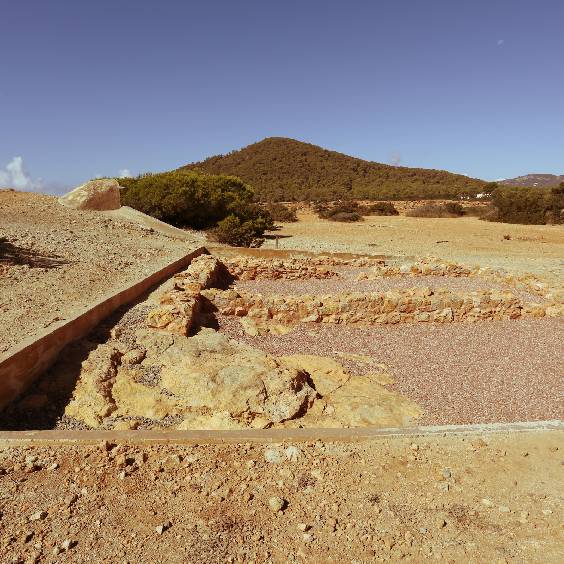
Their first settlement on the island, which they called Ibusim, was in Sa Caleta, near the coast. Over the centuries, the sea took its toll on part of the settlement, and the shoreline shifted. But other parts of the foundation walls of the settlement are still standing and can be visited today.
Ibiza rapidly gained importance, and the Punic people founded a second settlement, which was already located where Ibiza Town is today. They also built an underground city for the dead—a so-called necropolis. The existence of this large gravesite was forgotten for a long time until it was rediscovered in more recent times. The excavations there were important for learning about the Punic people. In their culture, grave goods played an important role. Not only do these goods reveal their crafting skills and sense of art, but if the provenance of the materials is analyzed, trade routes can be reconstructed. The necropolis, as well as a museum exhibiting grave goods, can be visited today.
The Punic people worshiped the gods Tanit and Bes. Bes is a creature somewhere between human and animal, not very beautiful. But he protects people, especially pregnant women and babies. For example, Bes keeps snakes away. And indeed, until recently, there were no snakes on Ibiza. Tanit, on the other hand, is the goddess of fertility and harvest.
Places to see:
- Sa Caleta
- Necropolis
The Romans and Others
During the centuries, another power rose in the Mediterranean area. The Romans grew stronger and stronger until they destroyed Carthage in 146 BC. Ibiza was controlled by the Romans from 123 BC onward. They refrained from destroying Ibiza, which they called Ebusus. In fact, the island was not a focus of Roman attention. As a result, the Punic culture, including the worship of Tanit and Bes, could continue. There is some archaeological evidence of Roman culture on Ibiza. They continued to use the necropolis, so it is also valuable for researching Roman culture.
There are also smaller excavations. The structures uncovered may not have a spectacular appearance, but it must be remembered that they are 2,000 years old. It is also said that early 20th-century Ibizan fishermen occasionally found Roman pottery from sunken ships in their nets.
After the fall of the Roman Empire, different groups took control of Ibiza. They had no notable cultural impact on the island. Overall, these times were very unstable, partly due to frequent pirate attacks.
Places to see:
- Aqueduct, Ibiza Town
The Moors on Ibiza and the Reconquest
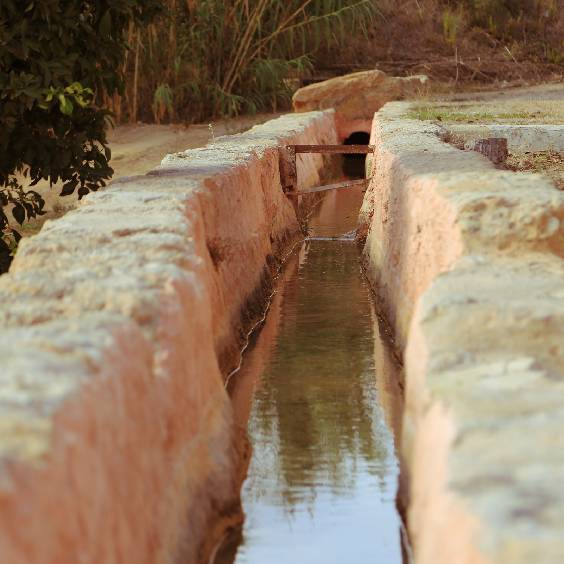
People from North Africa, commonly referred to as Moors, conquered Ibiza as well as the entire Iberian Peninsula. They introduced Islam to the island, which they called Yabisa, and reestablished trade. They not only traded salt, as the Punic people had, but also brought considerable agricultural knowledge to the island. They built terraces and complex irrigation systems, which significantly increased the harvest. The irrigation system in the Santa Eulària area dates back to this time.
The Christian sovereigns of Europe could not accept Moorish power over the Iberian Peninsula and soon began the reconquest. Though the process was very slow, they were ultimately successful. In fact, it took them around 700 years to complete the task. Ibiza was taken over by Christian sovereigns in 1235.
King James I of Aragon, also called “the Conqueror,” ruled the mainland north of Ibiza and was not satisfied with the size of his kingdom. So he expanded it westward, eastward, and to the Balearic Islands. For the conquest of Ibiza, he first hired Duke Nuño Sanchez and Pedro, a son of the Portuguese king. However, they did not even begin the mission on time. So, in a second attempt, James hired the Archbishop of Tarragona, Guillermo de Montgrí. Apparently, it was common at that time for clergymen to be involved in warfare. Nuño Sanchez and Pedro were upset upon their dismissal from this honorable and profitable mission. They complained, and the result was that James ruled they should do the job together.
How Ibiza was conquered is not documented. But there is a popular story: While the troops besieged Ibiza Town, an incident occurred. The sheikh desired his brother’s wife. This upset the brother so much that he committed treason against Ibiza. He told the attackers about a secret access to the town, so they could enter without fighting. The end of the secret passage is now a chapel in honor of the conquerors.
The Next 800 Years
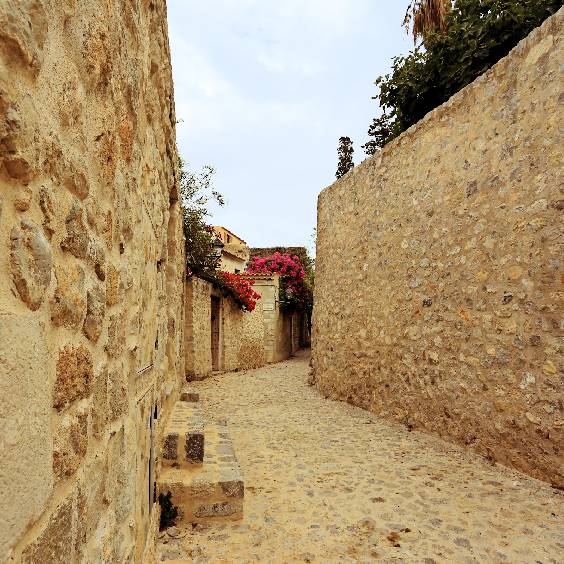
The three conquerors in the service of James I split the island into four parts—one for Sanchez, one for Nuño, and two for Montgrí, since he had financed the largest share of the troops. Ibiza Town and Salinas were declared common areas. An epoch of feudalism began. This means there was a king—in this case, James I of Aragon—who owned everything in his kingdom. He assigned the right to exploit smaller parts of his kingdom to vassals like the three men mentioned earlier. None of them actually lived on Ibiza, but they had bailiffs who would collect taxes, hold court, and lease the land to the inhabitants. Thus, there was a strict top-down structure, and everyone had to serve their master. The land and the people living there were considered assets, much like a business. This form of rule was common throughout Europe at that time.
Although in the following years Ibiza became part of different realms, there were no fundamental changes. When James I died, his kingdom was split between his sons, the half-brothers Peter III of Aragon and James II. Ibiza and the other Balearic Islands became the possession of James II, “King of Majorca.” It was Peter IV of Aragon who was able to defeat the other branch of the family and reunite the Kingdom of Aragon in 1344. Later, in 1469, Ferdinand II, King of Aragon, married Princess Isabella I of Castile, and thus the most important kingdoms on the Iberian Peninsula were effectively united, although the kingdoms formally remained independent for some time. As we can see, the sovereigns of Ibiza became further and further removed from the island. Politically and economically, quiet times began in Ibiza. However, pirate attacks remained frequent. So watchtowers were built, churches also served as fortifications in rural areas, and the impressive fortifications of Ibiza Town, as we know them today, were built in the 16th century. The churches, as well as the watchtowers, can be visited today at several places on the island. And of course, the part of Ibiza Town surrounded by the massive fortifications, called “Dalt Vila,” is a main tourist attraction today.
Places to see:
- Fortifications of Dalt Vila
- Watchtowers around the island
- Fortified churches at different places on the island
Continue reading and learn about Ibiza’s more recent history: "Make Love on Ibiza, Not War in Vietnam"